Car Speaker Specifications: 7 Checks Before a Wholesale Order
Two car speakers can carry the same size and wattage labels yet suit very different systems. For importers, distributors and private-label brands, a useful specification sheet must answer three questions: will the speaker fit, will it work with the intended system, and what exactly are we approving for the order?
ZEMINGTwo car speakers can carry the same size and wattage labels yet suit very different systems. For importers, distributors and private-label brands, a useful specification sheet must answer three questions: will the speaker fit, will it work with the intended system, and what exactly are we approving for the order?
Use these seven checks when comparing passive car speakers. Keep the approved drawing, specification revision and sample record together. This gives purchasing, installation and quality teams the same reference.
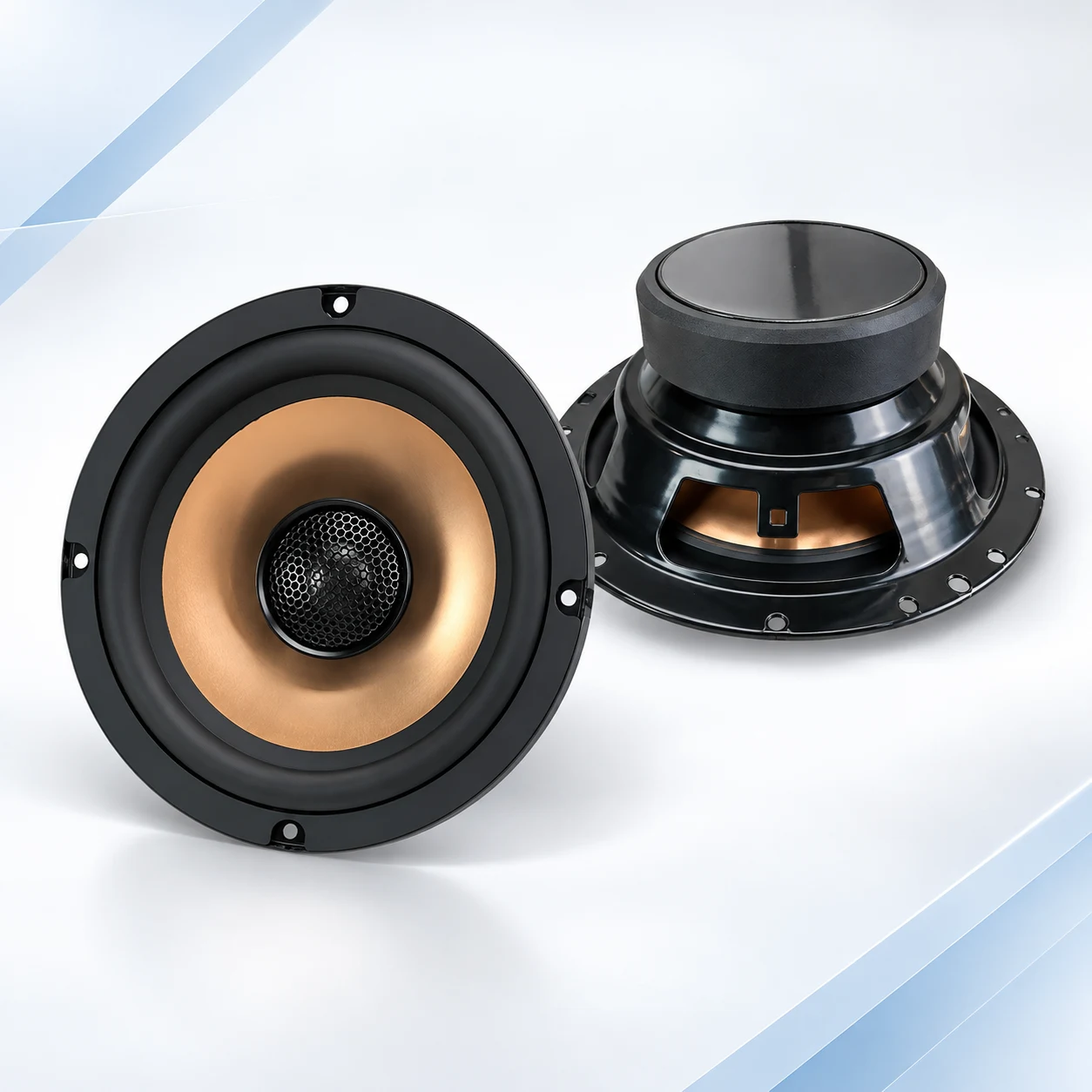
ZM-C65A product view. Confirm installation dimensions from the current drawing and sample.
The seven items to confirm before an order
Application: the intended vehicle or aftermarket sales channel, and the source of amplifier power.
Power handling: the rating definition, test conditions and whether it is per driver, set or pair.
Impedance: the nominal load and the amplifier’s supported operating configuration.
Sensitivity: the input reference, distance and measurement method.
Dimensions: the actual installation envelope, not just the nominal diameter.
Package contents: every driver, crossover, grille and accessory, with quantities.
Acceptance: the approved sample, agreed checks and process for handling changes.
1. Start with the system and the customer
Specify whether the speakers will run from a factory radio, an aftermarket head unit or a separate amplifier. For a vehicle-specific project, identify the model year, trim and factory audio option. A door location alone does not define the electrical system or available mounting space.
For a general aftermarket range, state your market, installer or retail channel, product type and target quantity. Mark requirements as essential or preferred. Ask suppliers to list any deviations in their quotation.
Compare our car speaker range, coaxial speakers and component speaker sets to choose the right product category before requesting a quote.
2. Compare defined power ratings
A large peak-power number is not a useful basis for comparing quotations. Ask for continuous power handling, often described as RMS in car-audio catalogs, and keep it separate from peak power.
What should the supplier specify?
Record the test signal, duration, frequency range, any protective filtering, and the method used to assess the result. Confirm whether the rating covers one driver, a complete component set or a pair. Record the intended amplifier and crossover settings separately.
Power handling describes an operating limit under stated conditions. It does not tell you how loud the speaker will be in a vehicle. Do not choose an amplifier from the peak rating alone.
3. Confirm the load before changing impedance
Nominal impedance, stated in ohms, describes the speaker’s rated electrical load. Check the amplifier’s permitted load for the exact channel configuration, including bridged operation if proposed. Physical fit does not establish electrical compatibility.
Do not treat a lower impedance as an automatic upgrade. It can change amplifier loading and output. For a factory-system replacement, confirm the original arrangement and any factory filtering. Request a separately identified sample if a supplier proposes an alternative impedance.
4. Put sensitivity figures on the same basis
Sensitivity describes sound output for a stated input and measurement setup. Ask whether the reference is 1 W at 1 m or a voltage such as 2.83 V at 1 m. Also request the frequency range or averaging method and measurement environment.
Why the reference matters
For a simplified resistive example, 2.83 V across 4 Ω corresponds to about 2 W. The same voltage across 8 Ω corresponds to about 1 W. A voltage-referenced figure therefore cannot automatically be read as a one-watt figure. Real loudspeaker impedance varies with frequency, so this calculation is only a comparison aid.
If the conditions differ or are missing, request comparable measurements rather than ranking speakers by the dB number alone.
5. Check a drawing and a physical sample
A “6.5-inch” label describes a size class. It does not guarantee the same mounting holes, cutout or depth.
Request a drawing that shows overall diameter, cutout, mounting-hole pattern, mounting depth, front projection and terminal position. Check clearance for the window mechanism, trim and grille in the actual installation. Include any adapter ring in that check.
Use product views such as the ZM-C65A coaxial speaker page to identify the proposed construction. Approve fit from the current dimensioned drawing and the sample, not a photograph alone.
6. Define what is inside each box
State whether the order covers individual drivers, coaxial pairs or complete component sets. A component set may require separate tweeters and crossover parts; confirm the proposed configuration rather than assuming every supplier includes the same items.
List quantities for speakers, tweeters, crossovers, grilles, brackets, fasteners, connectors and instructions. Confirm the retail-pack unit and master-carton quantity. Record required branding, labels, manual language and packaging artwork with their revision numbers.
7. Agree on sample acceptance before bulk production
“Good sound” is too vague for an approval record. Identify the sample, drawing revision, system setup and agreed checks. Useful checks include dimensional fit, polarity, abnormal noise, measured response under a defined setup, appearance and package contents.
Agree any limits and tolerances before testing. Record the test equipment and setup so results can be compared. A listening check can complement these checks, but should not replace the agreed measurements.
Keep an approved reference sample. Agree how proposed material or construction changes will be reviewed, how bulk goods will be inspected, and how discrepancies will be resolved. Confirm available test reports and any market-specific documentation for the exact product and project.
A short request for quotation you can copy
Please quote for [market and channel]. Product type: [coaxial / component set / individual driver]. Estimated quantity: [units or sets]. Intended system: [head unit or amplifier and channel configuration]. Required impedance: [value]. Installation limits: [drawing or dimensions].
Please provide defined power ratings and test conditions, sensitivity measurement conditions, a dimensioned drawing, exact package contents and a sample evaluation proposal. Branding and packaging requirements: [details]. Please identify deviations and confirm the project’s sample cost, MOQ and lead time.
Buyer FAQ
Does higher wattage mean a louder speaker?
No. Power handling and sound output are different. Compare sensitivity on a consistent basis and evaluate the speaker in the intended system.
Does matching the nominal diameter guarantee fit?
No. Check the cutout, hole pattern, depth, front clearance and terminals against the actual installation.
Should I reject a quote with incomplete sensitivity data?
Ask for the missing conditions first. Until the measurement basis is clear, the figure is not suitable for a direct comparison.
What should be approved before the first bulk order?
Approve the product specification, drawing, sample record, package contents and artwork. Confirm the commercial terms and how changes or inspection discrepancies will be handled.
Discuss your specification with ZEMING
Request a quote or product catalog. Send your product category, target quantity, intended system and drawing requirements. For a private-label project, add your branding and packaging brief and discuss OEM/ODM requirements. Sample arrangements, MOQ and lead time need confirmation for the specific project.
Technical reference
JBL’s published specification format illustrates separate RMS and peak figures, a voltage-referenced sensitivity rating and an itemized package list. It is a reference for reading specifications, not evidence of ZEMING product performance.